Text-based crime game: what we mean, and what we don’t
If you searched for a text-based crime game, here is the plain version about My Criminal Life: it runs on words, numbers and menus, it has painted illustrations, and you never type a command.
Sign-ups are open.
The honest description
My Criminal Life is illustrated and button-driven. Every action is a link or a button on an ordinary web page. There is no command line and no parser waiting for you to type “go north”, so it is not a MUD or a text adventure. It is also not an action game: there is no avatar, no 3D world and nothing happens in real time.
What it shares with the text-based games people usually mean is how it plays. The pages are built from words, tables and numbers. You make decisions by reading a list and choosing from it. The progress you care about is a number going up. If that is what “text-based” means to you, this is close. If you mean typed commands, it is not, and we would rather say so now than after you have signed up.
What text-driven means here
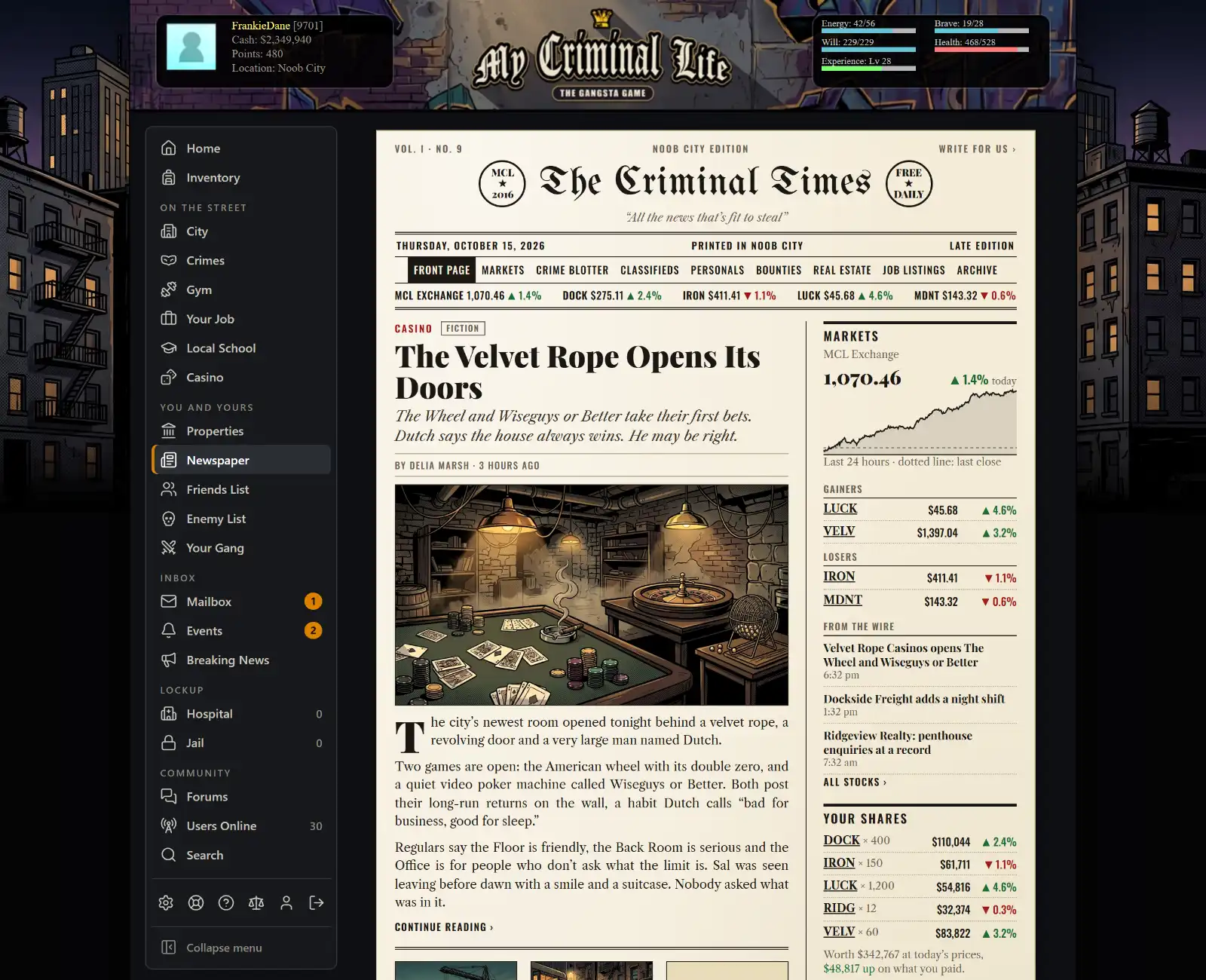
A lot of the game is reading. The Criminal Times is a daily newspaper with front-page stories, a crime blotter that says who is locked up, who is laid up and who is worth hunting, market prices and classified ads. Your mailbox holds letters from other players and from Vera at the pawn shop. The forums and the profile pages are written by players. Even the first week is a ledger you read through, job by job.
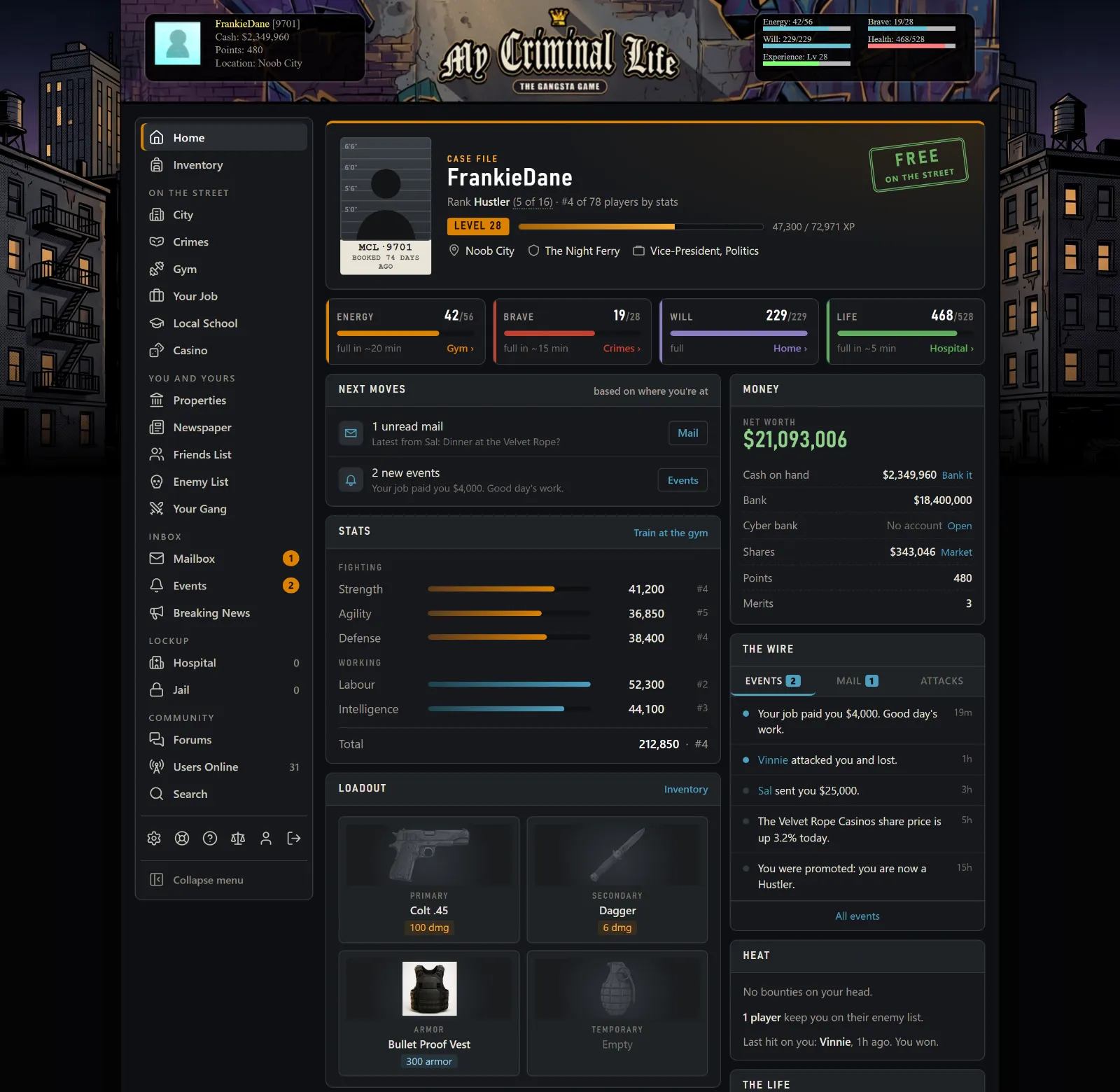
The numbers carry the rest. Four bars, energy, brave, will and health, say what you can do right now. Strength, agility, guard, labour and IQ say what you are good at. Your rank, from Nobody to Untouchable, says how far up you are. A locked crime shows the level it opens at, and the game never shows you the odds of a crime, so you learn them by doing.
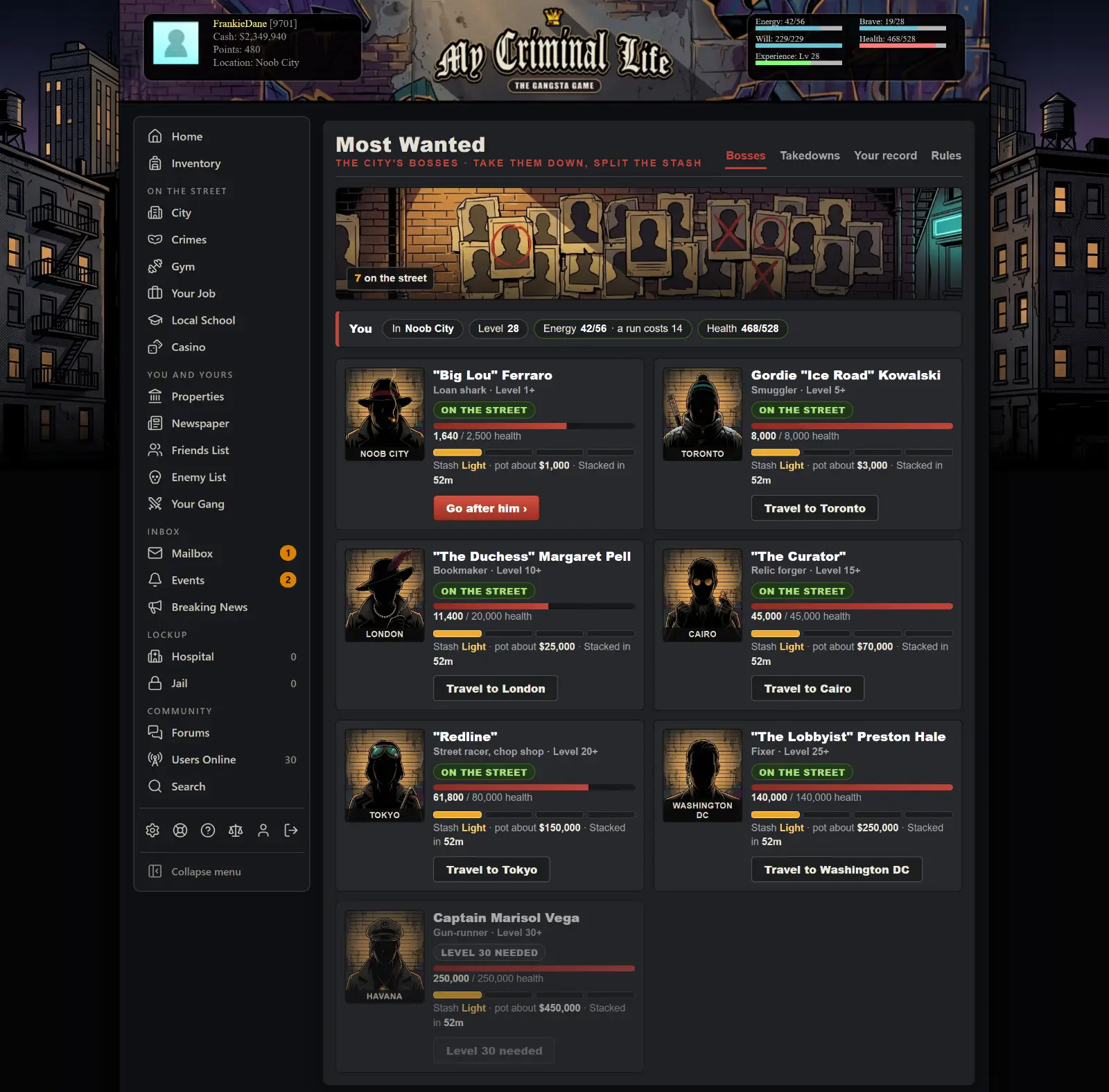
The art does a different job. It tells you where you are: the painted city map, a picture for each of the fifteen places to live, the casino floor, the church, the dump, a boss on a wanted poster. You look at it for a second and go back to reading.
One turn, start to finish
Here is a typical visit, with nothing hidden. You sign in and read your case file. Brave is full, so you open the crime list and choose one. The game spends the brave and tells you in a sentence what happened. A success pays cash and experience. A failed crime pays nothing and can send you to the County Lockup, where a timer counts down and you can wait it out, pay bail or hope another player busts you out.
Then you go to the gym, pick a stat and spend some energy. You check the newspaper, glance at the hospital and the jail lists, and maybe search for another player and attack. If you win, you choose how it ends: mug them, hospitalize them or leave them. Then you close the tab. The bars refill while you are away, and the city keeps moving.
A visit like that takes ten or fifteen minutes. A longer one has more to do, but it never needs more attention than you want to give it.
Why some people prefer it
Pages made of text and numbers load quickly and read well on a small screen. There is no skill test of reflexes, so a ten-minute visit on a phone is as good as an hour at a desk. Because every action spends a bar, you plan. You decide whether to spend your brave on a crime now or hold it, whether to train or save energy for a fight. Those decisions are most of the game.
Who should look elsewhere
Look elsewhere if you want to type commands, if you want a character you can walk around a map, or if you want combat that rewards fast hands. My Criminal Life has none of that. If you want a game you can think about between other things, with other real players in it, read on: the browser crime game page shows the first hour, and the PBBG guide explains the family of games it belongs to.
Quick answers
Is My Criminal Life a text game?
Partly. It is built from words, numbers and menus, and the newspaper, the mail and the forums are all reading. It is also illustrated, and you play it by clicking buttons and links. It is not a typed-command game.
Do I type commands?
No. Every action is a button or a link on a page: pick a crime, pick a gym stat, press Attack. Typing is for messages, forum posts and the sign-in form.
Does it have graphics?
Yes, in a comic-book style: a painted city map, a picture for every home, the casino, the church and the dump, and a portrait for each Most Wanted boss. Nothing moves in real time and there is no avatar to steer.
Can I talk to other players?
Yes. There is a mailbox, forums, a chat dock, and friends and enemies lists. Gangs have their own pages too.
Does it work on a phone?
Yes. The pages fit a phone screen, and it works in a current browser on a phone, a tablet or a computer. There is no app to install.
More answers are in the full FAQ.
More about the game
Browser crime game
What a crime game that runs in a web page is, and what your first hour in this one looks like.
What is a PBBG?
Persistent browser-based games in plain English, with the bars and timers of this one as the example.
How to play
Your first day in Noob City: the bars, crimes, the gym, jobs, jail and levelling up.
The city map
Noob City's seven districts, what is in each, and how to get around.
The front page
What the game is, in one screen, and how to start.
About the game
The city, the ranks and the people who run it.
Ready to try it?
Make an account with your email. It’s free, it works on your phone, and you have to be 18 or older.
Sign-ups are open.